Pope Clement V Family Relationship to French King Phil
| Clement V | |
|---|---|
 | |
| Nascence name | Raymond Bertrand de Got |
| Papacy began | November 14, 1305 |
| Papacy ended | April 20, 1314 |
| Predecessor | Benedict 11 |
| Successor | John XXII |
| Built-in | 1264 Villandraut, Gascony, French republic (?) |
| Died | April 20 1314 Avignon, France |
| Other popes named Clement | |
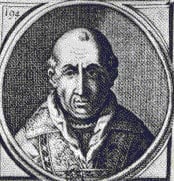
Pope Clement V (1264 – April twenty, 1314), built-in Bertrand de Goth (also occasionally spelled "Gouth" and "Got"), was Pope from 1305 to his death. He is memorable in history for suppressing the order of the Templars, and every bit the Pope who moved the Roman Curia to Avignon in 1309. He was Philip IV The Off-white's personal selection for Pope, and more or less served Philip'south interests. However, despite a reputation for greed and weakness, he did not lack courage. Initially, he was reluctant to suppress the Templars and also refused to condemn Boniface VIII, which Philip allegedly made a status of supporting his papacy. More interested in honors and in sinecure than in spiritual leadership, his tenure every bit pope was not entirely a failure. No Pope could survive at this fourth dimension without strong support from a temporal ruler or rulers, and Italy was an increasingly dangerous place, described past Shahan as "quasi-anarchical" at the time.[one] The claim that the move to Avignion was to protect the papacy was non entirely false. Clement, weak though he was and in many respects the pawn of the French king, did retain some cocky-dignity and independence. In the thing of condemning Boniface VIII, says Chamberlain, "Cloudless, pliant creature of the male monarch though he was cheated him of this last satisfaction" and "the trial never came to a verdict."[2]
Contents
- 1 Biography
- 1.1 Papal election
- 1.2 The king and the popes
- ane.three Suppression of the Knights Templar
- 1.iv The Babylonian Captivity
- i.5 Italy and Cloudless'south pontificate
- 1.vi England, Scotland, and Clement 5
- 1.vii Suppression of the Fra Dolcino
- 2 Death and legacy
- three Notes
- 4 References
- 5 External links
- 6 Credits
Cloudless may have sincerely wanted to serve God. He did his best, inside difficult circumstances, to protect the prestige of the papacy, even if he was not its most able, saintly, or visionary incumbent.
Biography
Born in Villandraut, Aquitaine, Bertrand was canon and sacristan of the church of Saint-André in Bordeaux, and so vicar-general to his brother, the archbishop of Lyon, who in 1294, was created Cardinal Bishop of Albano. He was then made bishop of St Bertrand-de-Comminges, the cathedral church building of which he was responsible for profoundly enlarging and embellishing; and chaplain to Pope Boniface VIII (1294–1303), who made him archbishop of Bordeaux in 1297. Technically, Bertrand was a bailiwick of the King of England, whose territory included Bordeaux.
Papal ballot
Following the expiry of Bridegroom XI in 1304, he was elected Pope Clement V in June 1305 (and was consecrated on November 14), after a yr's interregnum occasioned past the disputes between the French and Italian cardinals, who were nigh equally counterbalanced in the conclave, which had to be held at Perugia. Bertrand was neither Italian nor a cardinal, and his election might have been considered a gesture towards neutrality. The contemporary chronicler, Giovanni Villani, reported gossip that he had bound himself to King Philip IV of France (1285–1314) by a formal agreement previous to his pinnacle, made at St. Jean d'Angély in Saintonge. Whether this was truthful or not, it is likely that the hereafter pope had weather laid down for him by the conclave of cardinals. He had, however, known Philip since his own youth. At Bordeaux, Bertrand was formally notified of his election and urged to come up to Italian republic; merely he selected Lyon for his coronation, Nov 14, 1305, which was celebrated with magnificence and attended past Philip IV. Amongst his beginning acts was the creation of nine French cardinals.
The king and the popes
Philip IV The Fair of French republic'southward understanding of his role as God's representative on earth ran counter to the instruction of the Cosmic Church, strongly upheld by Boniface VIII and his successor, Benedict XI that the Pope was God'south representative in both the temporal and the spiritual realm. The papal coronation included the words, "Know that thou fine art the father of princes and kings—the ruler of the world" and some Popes took this to "its logical cease."[iii] According to Howarth, the Capetian kings believed themselves, or were believed to exist by their subjects, "semi-divine" whose "touch, reputedly, could cure disease."[4] In his cocky-understanding, Philip was a "priest-king" and and then felt entitled to tax the clergy, fifty-fifty though this contravened papal authority. It was this cocky-understanding that brought Philip into direct conflict with Pope Boniface VIII, "whose will was as strong equally Philip'south, and whose dream was identical, the spousal relationship of all authority, temporal and spiritual, in his person."[5] Boniface issued the bull, Unam Sanctam, proclaiming his authority over kings, and excommunicated the money-strapped Philip for levying taxes on the Church building. Philip responded by arresting one of the French Bishops known to be close to the Pope, and past convening an Assembly of French nobles, scholars, and prelates that condemned the Pope. Philip so dispatched his agent, William Nogaret, to Anagni, the Pope'due south summer retreat in the hills east of Rome to arrest Boniface himself. Boniface was rescued by the people of the city three days later, just died inside a calendar month. His successor, Benedict was "bandage in the same mold" merely was himself expressionless inside the year. Information technology was at the subsequent papal election that the French archbishop Bertrand de Goth was elected pope every bit Cloudless Five with Philip'south enthusiastic stiff support. Howarth (1982) says that Philip:
knew what he was doing in supporting de Got'due south nomination; he knew the human well. The archbishop was a weak and greedy man, fond of accolade and disliking responsibleness; he had attained his archbisopric through family influence, for his uncle was a bishop and his brother an archbishop.[6]
Clement knew that he was Pope considering of Philip's support, and he restored the Male monarch to good standing. Early in 1306, he explained away those features of the bulls Clericis Laicos that might seem to utilise to the King of France and substantially withdrew Unam Sanctam, the two bulls of Boniface VIII which were specially offensive to Philip Iv's ambitious ministry. He appears to have conducted himself throughout his pontificate equally the mere tool of the French monarchy, a radical change in papal policy.
Suppression of the Knights Templar
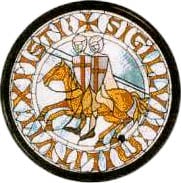
The Seal of the Knights Templar
On October 13, 1307, came the arrest of hundreds of the Knights Templar in France, an action apparently financially motivated and undertaken by the efficient royal bureaucracy to increment the prestige of the crown. Philip Four was the force backside this ruthless motion, but information technology has too tarnished the historical reputation of Clement V. From the very solar day of Clement V's coronation, the King had charged the Templars with heresy, immorality, and abuses, and the scruples of the Pope were compromised past a growing sense that the burgeoning French Country might non wait for the Church, merely would proceed independently. Clement was initially slow to respond to these charges and "with considerable courage … refused to give the king an reply … at once."[seven]. He tried to "fend off" Philip's "demand for an inquiry" until Philip ordered the arrest of all members of the order. Clement interpreted this as an attack on the Church itself, and issued a balderdash ordering the "kings of the Christian lands … to arrest the Templars in their countries" but to do so in the name of the Pope.[viii] Cloudless may have hoped that the Templars' innocence would exist proved, so yielded to the King'southward pressure to motility against them. However, charged with heresy, sodomy, and all manners of abominations, they were, despite Clement's delaying tactics, eventually found guilty. Clement tried to avert taking personal responsibility past sending a delegation of Cardinals to Paris to interrogate the prisoners.
In 1311, Quango of Vienne was convened to pass judgment. Well-nigh of its 300 members thought the charges unproved just Philip himself testified to the guild'due south guilt. Then, the Bull Vox in excelsis, dated March 22, 1312, written by Clement, was read. In this Balderdash, "the pope said that though he had no sufficient reasons for a formal condemnation of the gild, however, because of the common weal, the hatred borne them by the King of French republic, the scandalous nature of their trial, and the probable dilapidation of the gild'due south property in every Christian land, he suppressed it by virtue of his sovereign power, and non by any definitive sentence." Many of the knights were executed, and the order'south wealth was confiscated. Although the club's avails were meant to devolve to the Hospitallers, they were appropriated by Philip. The guilt or innocence of the Templars is 1 of the more difficult historical problems, partly because of the atmosphere of hysteria that had built upwardly in the preceding generation and the habitually intemperate language and improvident denunciations exchanged between temporal rulers and churchmen, and partly because the subject has been embraced past conspiracy theorists and pseudo-historians. Shahan suggests that Cloudless may have given in on the consequence of the Templars in guild to strengthen his own hand in resisting Philip's desire to accept Boniface condemned, "to represent both with Apostolic courage might accept meant intolerable consequences, non but personal indignities, but in the cease the graver evil of schism nether atmospheric condition especially unfavorable for the papacy."[9]
The Babylonian Captivity
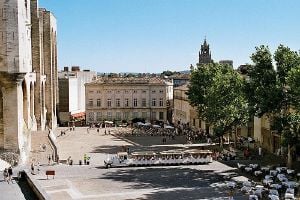
Square beneath the Palace of the Popes, Avignon
In March 1309, the entire papal court settled at Avignon, which was non and so role of France but an imperial fief held by the Rex of Sicily. The removal of the Papacy to Avignon was justified at the time by French apologists on grounds of security, since Rome, where the dissensions of the Roman aristocrats and their armed militia had reached a nadir, and where the Basilica di San Giovanni in Laterano had been destroyed in a fire, was unstable and dangerous. But the determination proved the precursor of the long Avignon Papacy, the "Babylonian captivity" (1309–77), in Petrarch's phrase, and marks a indicate from which the decay of the strictly Cosmic conception of the pope every bit universal bishop may exist dated.
Meanwhile, Philip Iv's lawyers pressed to reopen Nogaret'due south charges of heresy against the late Boniface VIII that had circulated in the pamphlet war around Unam sanctam. Cloudless V had to yield to pressures for this extraordinary trial, begun February 2, 1309, at Avignon, which dragged on for two years. In the document that called for the witnesses, Clement 5 expressed both his personal conviction of the innocence of Boniface 8 and his resolution to satisfy the King. Finally, in Feb 1311, Philip Iv wrote to Cloudless V abandoning the process to the hereafter council of Vienne. For his part, Cloudless V absolved all the participants in the abduction of Boniface at Anagni. During his pontificate, Cloudless elevated five members of his own family unit to the college of Cardinals.[10] He canonized the one-time Pope, Celestine Five (pope for five months and eight days in 1249), whom Boniface had imprisoned (equally St. Peter). Celestine had been a hermit earlier his election as Pope, and was the candidate of a reformist party. Generous to a error, he "reduced the hierarchy to chaos with his coincidental gifts."[11] Oddly, Celestine'due south brief papacy (he resigned, and was and then imprisoned by his successor, who feared that he notwithstanding had a claim to exist the legitimate Pope) suggests that a deeply spiritual man was actually, every bit pope, an "anomaly—the ability to be exercised was the same type as that exercised by any other monarch."[12]
Italian republic and Clement's pontificate
Clement V's pontificate was as well a disastrous time for Italian republic. The Papal States were entrusted to a squad of three cardinals, but Rome, the battleground of the Colonna and Orsini factions, was ungovernable. In 1310, the Emperor Henry Seven (1308–thirteen) entered Italy, established the Visconti as vicars in Milan, and was crowned by Clement V'due south legates in Rome (1312) before he died near Siena in 1313. However, Cloudless threatened the Emperor with excommunication in 1313, over his intent to wage war against Robert of Naples, whom Clement declared Emperor afterwards Henry'south decease.
In Ferrara, papal armies clashed with Venice. When excommunication and interdict failed to have their intended effect, Clement V preached a crusade against the Venetians, a symptom of how polarized that detail conflict had become.
England, Scotland, and Cloudless V
Cloudless intervened in a dispute between Edward I of England and the Archbishop of Canterburry, supporting the former and suspending the latter. He excommunicated Robert Bruce in 1306, for murdering his rival, John Comyn during mass. He also deposed several Scottish bishops supporting a national uprising against English language rule.
Suppression of the Fra Dolcino
Other remarkable incidents of Cloudless V's reign are his fierce repression of the Fra Dolcino, a reformist movement which he considered a heresy, in Lombardy, and his promulgation of the Clementine Constitutions in 1313. The Dolcino opposed the bureaucracy, the feudal arrangement, supported individual freedom and preached equality and common ownership of belongings. They denounced the worldly power and wealth of the papacy. Various popes, who plant themselves answering criticism of their worldly ability and possessions, replied that in lodge to serve and not to be served, the Church needed to be wealthy.
Death and legacy
Clement V died in April 1314. According to one story, while his body was lying in country, a thunderstorm developed during the night and lightning struck the church where his body lay, igniting the building. The burn down was and so intense that, when information technology was extinguished, the body of Pope Clement V was well-nigh completely destroyed. He is buried at La Chaise-Dieu in Auvergne.
Clement V is often remembered for his declared nepotism, reported avarice, weakness, and cunning, and is often vilified as a willing collaborator in the designs of France against the Pope, who ushered in a century of schism: In the Divine Comedy, Dante is shown the place which awaits Cloudless V in the eighth circle of Hell. He is recorded as the first pope to be crowned with a papal tiara. Chamberlain described Cloudless as "the timorous pope, who … cowered benathy the French king."[13] On the other paw, he was courageous in initially opposing Philip's motility against the Templars and in resisting the King over Boniface'due south condemnation, fifty-fifty though he owed his own position to the French king. Cloudless besides published some writings on Canon Law, the Clementinae. Duffy describes Clement as a "good ambassador." He was "deeply committed to the crusading ideal" and also consolidated the relationship between the Church building and the Universities, "founding chairs in Oriental languages at Paris, Oxford, Bologna, and Salamanca."[14]
Notes
- ↑ Thomas J. Shahan, Cloudless V. Retrieved October vi, 2007.
- ↑ Chamberlain, p 123.
- ↑ Chamberlain, p 122.
- ↑ Howarth, p 252.
- ↑ Ibid p 254.
- ↑ Howarth, p 261.
- ↑ Ibid, p 271
- ↑ Ibid, p 284.
- ↑ Shahan.
- ↑ Duffy, p 164.
- ↑ Chamberlain, p 84.
- ↑ Ibid, p 95.
- ↑ Chamberlain, p 131
- ↑ Duffy, p 164.
References
ISBN links support NWE through referral fees
- Chamberlain, Eastward. R. The Bad Popes. NY: Barnes & Noble, 1993. ISBN 9780880291163
- Duffy, Eamon. Saints and Sinners: A History of the Popes. New Haven, CT: Yale Academy Press, 2006. ISBN978-0300115970
- Howarth, Stephen. The Knights Templar. New York: Barnes and Noble, 1982. ISBN 9780880296632
- Maxwell-Stuart, P. Chiliad. Chronicle of the Popes: The Reign-by-Reign Tape of the Papacy over 2000 Years. London: Thames & Hudson, 1997. ISBN 978-0500017982
- Menache, Sophia. Clement V. Cambridge: Cambridge University Press, 2002. ISBN 0-521-52198-X
External links
All links retrieved March 3, 2017.
- " Pope Clement V in the 1913 Catholic Encyclopedia
| Popes of the Cosmic Church | |||||||||
|---|---|---|---|---|---|---|---|---|---|
| |||||||||
| Currently: Francis | |||||||||
Credits
New World Encyclopedia writers and editors rewrote and completed the Wikipedia article in accordance with New World Encyclopedia standards. This article abides past terms of the Creative Commons CC-by-sa 3.0 License (CC-by-sa), which may be used and disseminated with proper attribution. Credit is due under the terms of this license that tin can reference both the New World Encyclopedia contributors and the selfless volunteer contributors of the Wikimedia Foundation. To cite this commodity click here for a list of adequate citing formats.The history of before contributions by wikipedians is attainable to researchers here:
- Cloudless Five history
The history of this article since it was imported to New World Encyclopedia:
- History of "Clement V"
Note: Some restrictions may apply to use of individual images which are separately licensed.
Source: https://www.newworldencyclopedia.org/entry/Clement_V

Post a Comment for "Pope Clement V Family Relationship to French King Phil"