How Did You Know I Was Congolese Meme
Memes have become expressions of contemporary civilization worldwide, as people certificate their daily lives through images. The earth of memes – the humorous images paired with text that mutate and spread rapidly, depending on how funny they are – remind u.s.a. that humour is also contagious.
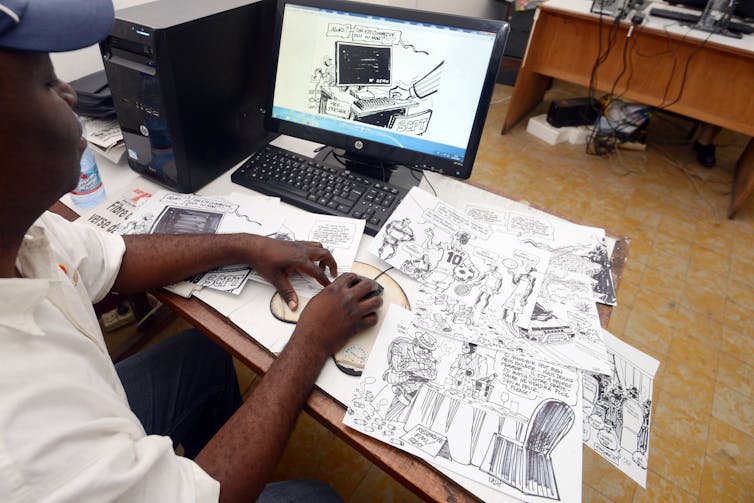
Cartoonists in Africa have also historically engaged their readers through the use of humour. Their expressions become fodder for conversations in public spaces similar crowded buses and bars. In the colonial era, cartoons and popular paintings were instrumental in the struggle for independence in many African countries.
In postcolonial settings they continue to be mediums that covertly – and sometimes explicitly – mock and challenge abuses of power.
In that location's some continuity when comparing memes to cartoons. Merely the anonymity offered by the virtual quality of meme apportionment allows for a different kind of participation.
Photoshopped images of politicians in compromising situations – being caught with their pants down – offer a carnivalesque commentary on the arbitrariness of power. These images galvanise people to express joy at those in ability, merely as well those who are subjected to it.
There are an estimated 5.3 million agile internet users in the Congo-kinshasa (DRC). But access to applied science is limited to people with the financial means. Because censorship in the country is rife, the online sphere, with its anonymity, provides a platform through which power can be critiqued. The economy of circulating images represents a threat to a authorities that often shuts off the internet during electoral periods.
There has been an increment in academic interest about circulating digital content. Merely there's been virtually no research exploring memes and other viral media in Africa. Commencement in 2017, nosotros began researching memes and their apportionment in the DRC's capital letter urban center, Kinshasa.
This research has provided some insights into the cultural characteristics of digital images in the DRC. And also how they relate to larger anxieties about social change and foreign interventions and new forms of online connection.
Pondu, Versace and the Chinese
In many of the memes we collected at that place was a sense of self-reflexive laughter, an ironic self-mockery, that characterised the images. For case, one meme presents an image of Victor Hugo, a 19th century French writer, superimposed on an image of a plate of pondu, a Congolese national dish, with a quote supposedly from Hugo himself: "A real woman knows how to melt Pondu."
Another meme depicts a man in head to toe Versace impress and a trolley stacked with luggage emblazoned with the luxury way make logo. The explanation: "When your Congolese uncle comes to visit for a week." These images appeal to people living at home and abroad as they express cultural affinities through images (one might say caricatures) of Congolese culture. This one holds upward the stereotype of Congolese people every bit obsessed with manner.
At that place is a profusion of images depicting Chinese people. These range from light-hearted provocations most cultural stereotypes to some that carry more serious allegations of corruption of ability. One meme we collected presents a Chinese-endemic shop in the DRC featuring a mannequin mimicking a stereotypical Congolese silhouette. Others are suggestive of more serious racial stereotypes. For instance, a Chinese street-nutrient vendor selling grilled rats is ridiculed in one meme. Information technology bears the inscription, "Take yous eaten still?"
Digital content and other oral channels similar rumours can get intertwined, and feed one another, which presents a potential danger. For instance, the image of a Chinese woman selling grilled rats might be read as legitimate news rather than a playful jab.
Images might exist used to dispense people's attitudes, particularly if people are non aware of the complexities of net content product. This points to the importance of the promotion of internet literacy in the country.
Technological anxieties
There are growing assumptions that memes and viral content tin can alter opinions in a manner that many characterise as manipulation. New psychology studies have raised questions about the bureau of the memetic receiver. They propose that exposure to conspiracy theories is sometimes enough to significantly influence one's conventionalities. Take the proliferation of memes circulating across Africa about Chinese people. Many are intended to be comical, merely others get vehicles of simulated data that tin can affect people's perceptions.
Biological viruses can contaminate, simply technology also becomes a means through which contagion can occur. Local conventionalities systems of virality tin converge with the notion that images themselves can exist potentially virulent, infecting people'south minds on a literal level. For example, it is non uncommon for a Congolese person to say, "Do not infect my phone with that video of yours. I practise non want to be contaminated by those images."
Baca juga: How new media platforms take become powerful beyond Africa
This item argument speaks not as much to a digital virus as to beliefs about the power of images themselves. Given the threat of Ebola outbreaks, as well equally the COVID-nineteen pandemic, linguistic communication relating to contamination is particularly salient.
As more people, technology and ideas go along to circulate, anxieties about the proximity of others will go along to brand themselves visible through the multiplication of narratives. These narratives now also appear in the memes that people make, circulate and laugh at.
It's undeniable that the ambivalence of digital technology contributes to our relationships with others. Concerns over contamination, whether cultural or biological, will continue to brood and be fed by the digital domain, contributing to ambivalence towards structural forces circulating in the world.
As the technology used to access and create cyberspace content becomes increasingly bachelor to Congolese people, locally produced content will inevitably continue to multiply and interact with global trends equally well every bit to critique the wider political sphere.
Source: https://theconversation.com/how-memes-in-the-drc-allow-people-to-laugh-at-those-in-power-and-themselves-148924

Post a Comment for "How Did You Know I Was Congolese Meme"