Friend of Foe


Model XAE IFF kit, the first radio recognition IFF organisation in the U.S.
Identification, friend or foe (IFF) is an identification system designed for control and command. It uses a transponder that listens for an interrogation signal and so sends a response that identifies the broadcaster. IFF systems usually use radar frequencies, but other electromagnetic frequencies, radio or infrared, may exist used.[1] It enables military and civilian air traffic command interrogation systems to place shipping, vehicles or forces as friendly and to determine their bearing and range from the interrogator. IFF is used by both military and civilian shipping. IFF was outset developed during World War Ii, with the arrival of radar, and several friendly fire incidents.
IFF tin merely positively identify friendly shipping or other forces.[2] [3] [4] [5] If an IFF interrogation receives no reply or an invalid reply, the object is not positively identified every bit foe; friendly forces may not properly reply to IFF for various reasons such as equipment malfunction, and parties in the area not involved in the combat, such as civilian airliners, volition not be equipped with IFF.
IFF is a tool within the broader armed forces action of Gainsay Identification (CID), the label of objects detected in the field of combat sufficiently accurately to support operational decisions. The broadest characterization is that of friend, enemy, neutral, or unknown. CID not but can reduce friendly fire incidents, but too contributes to overall tactical decision-making.[half dozen]
History [edit]
With the successful deployment of radar systems for air defence during World War Ii, combatants were immediately confronted with the difficulty of distinguishing friendly shipping from hostile ones; by that time, shipping were flown at loftier speed and altitude, making visual identification impossible, and the targets showed up as featureless blips on the radar screen. This led to incidents such as the Battle of Barking Creek, over United kingdom,[7] [8] [nine] and the air attack on the fortress of Koepenick over Germany.[10] [11]
British Empire [edit]
Early concepts [edit]
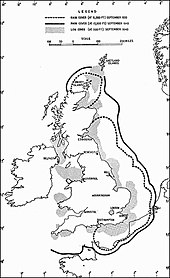
Already earlier the deployment of their Concatenation Home radar system (CH), the RAF had considered the problem of IFF. Robert Watson-Watt had filed patents on such systems in 1935 and 1936. By 1938, researchers at Bawdsey Manor began experiments with "reflectors" consisting of dipole antennas tuned to resonate to the primary frequency of the CH radars. When a pulse from the CH transmitter striking the aircraft, the antennas would resonate for a short time, increasing the amount of energy returned to the CH receiver. The antenna was continued to a motorized switch that periodically shorted information technology out, preventing information technology from producing a bespeak. This caused the return on the CH set to periodically lengthen and shorten every bit the antenna was turned on and off. In exercise, the arrangement was found to exist too unreliable to use; the return was highly dependent on the direction the aircraft was moving relative to the CH station, and often returned petty or no additional signal.[12]
It had been suspected this system would be of petty employ in practice. When that turned out to be the case, the RAF turned to an entirely dissimilar system that was also being planned. This consisted of a set of tracking stations using HF/DF radio management finders. Their shipping radios were modified to send out a 1 kHz tone for xiv seconds every minute, allowing the stations aplenty time to measure the aircraft'due south bearing. Several such stations were assigned to each "sector" of the air defence system, and sent their measurements to a plotting station at sector headquarters, who used triangulation to determine the aircraft's location. Known as "pip-squeak", the organization worked, but was labour-intensive and did non display its information directly to the radar operators. A organization that worked direct with the radar was clearly desirable.[13]
IFF Mark Ii [edit]
The start agile IFF transponder (transmitter/responder) was the IFF Marking I which was used experimentally in 1939. This used a regenerative receiver, which fed a modest amount of the amplified output dorsum into the input, strongly amplifying even small signals as long as they were of a unmarried frequency (like Morse code, but unlike vox transmissions). They were tuned to the signal from the CH radar (twenty–30 MHz), amplifying information technology so strongly that information technology was broadcast back out the aircraft's antenna. Since the signal was received at the aforementioned time equally the original reflection of the CH signal, the outcome was a lengthened "blip" on the CH brandish which was easily identifiable. In testing, it was found that the unit would often overpower the radar or produce likewise little bespeak to be seen, and at the same time, new radars were existence introduced using new frequencies.
Instead of putting Mark I into production, a new IFF Mark Two was introduced in early 1940. Marking 2 had a serial of split tuners inside tuned to unlike radar bands that it stepped through using a motorized switch, while an automated gain command solved the problem of it sending out too much signal. Mark II was technically complete every bit the state of war began, but a lack of sets meant information technology was non bachelor in quantity and only a small number of RAF shipping carried it by the time of the Boxing of Britain. Pip-squeak was kept in operation during this menstruum, but equally the Battle ended, IFF Mark Two was speedily put into full functioning. Pip-squeak was yet used for areas over land where CH did not embrace, equally well every bit an emergency guidance organization.[14]
IFF Mark Three [edit]
Even by 1940 the complex arrangement of Mark Ii was reaching its limits while new radars were being constantly introduced. By 1941, a number of sub-models were introduced that covered different combinations of radars, mutual naval ones for instance, or those used past the RAF. But the introduction of radars based on the microwave-frequency cavity magnetron rendered this obsolete; there was simply no manner to make a responder operating in this band using contemporary electronics.
In 1940, English engineer Freddie Williams had suggested using a single split frequency for all IFF signals, but at the time there seemed no pressing need to change the existing organization. With the introduction of the magnetron, work on this concept began at the Telecommunications Research Establishment as the IFF Mark III. This was to get the standard for the Western Allies for most of the war.
Mark III transponders were designed to answer to specific 'interrogators', rather than replying directly to received radar signals. These interrogators worked on a express selection of frequencies, no thing what radar they were paired with. The system too immune limited communication to be made, including the power to transmit a coded 'Mayday' response. The IFF sets were designed and built by Ferranti in Manchester to Williams' specifications. Equivalent sets were manufactured in the U.s.a., initially every bit copies of British sets, so that centrolineal aircraft would be identified upon interrogation by each other'south radar.[14]
IFF sets were patently highly classified. Thus, many of them were wired with explosives in the upshot the aircrew bailed out or crash landed. Jerry Proc reports:
Alongside the switch to turn on the unit was the IFF destruct switch to prevent its capture past the enemy. Many a pilot chose the wrong switch and blew up his IFF unit. The thud of a contained explosion and the acid smell of burning insulation in the cockpit did not deter many pilots from destroying IFF units time and time once more. Eventually, the self destruct switch was secured past a sparse wire to forbid its accidental employ."[15]
Germany [edit]

Lawmaking generator from German WW Ii IFF-Radio FuG 25a Erstling
FuG 25a Erstling (English: Firstborn, Debut) was developed in Germany in 1940. It was tuned to the depression-VHF ring at 125 MHz used by the Freya radar, and an adaptor was used with the depression-UHF-banded 550–580 MHz used by Würzburg. Before a flight, the transceiver was gear up with a selected mean solar day code of x bits which was dialed into the unit. To start the identification procedure, the ground operator switched the pulse frequency of his radar from 3,750 Hz to 5,000 Hz. The airborne receiver decoded that and started to transmit the day code. The radar operator would and so run into the blip lengthen and shorten in the given code, ensuring it was not being spoofed. The IFF transmitter worked on 168 MHz with a power of 400 watts (PEP).
The system included a way for basis controllers to determine whether an aircraft had the right code or not but information technology did not include a fashion for the transponder to refuse signals from other sources. British military scientists institute a way of exploiting this by building their ain IFF transmitter chosen Perfectos, which were designed to trigger a response from whatsoever FuG 25a system in the vicinity. When an FuG 25a responded on its 168 MHz frequency, the signal was received by the antenna system from an AI Mk. IV radar, which originally operated at 212 MHz. By comparison the strength of the signal on different antennas the direction to the target could exist determined. Mounted on Mosquitos, the "Perfectos" severely limited High german utilize of the FuG 25a.
Further wartime developments [edit]
IFF Mark Four and 5 [edit]
The Us Naval Research Laboratory had been working on their own IFF system since before the state of war. It used a single interrogation frequency, similar the Mark Iii, but differed in that it used a dissever responder frequency. Responding on a different frequency has several practical advantages, most notably that the response from one IFF cannot trigger another IFF on another aircraft. But it requires a complete transmitter for the responder side of the circuitry, in contrast to the profoundly simplified regenerative system used in the British designs. This technique is now known as a cross-band transponder.
When the Mark II was revealed in 1941 during the Tizard Mission, information technology was decided to utilise it and take the fourth dimension to further improve their experimental system. The result was what became IFF Marker IV. The main difference betwixt this and earlier models is that it worked on higher frequencies, around 600 MHz, which allowed much smaller antennas. Still, this also turned out to exist close to the frequencies used by the German Würzburg radar and there were concerns that it would be triggered by that radar and the transponder responses would be picked on its radar display. This would immediately reveal the IFF's operational frequencies.
This led to a US–British effort to brand a further improved model, the Mark V, also known as the United nations Beacon or UNB. This moved to even so higher frequencies around ane GHz just operational testing was not complete when the state of war concluded. Past the time testing was finished in 1948, the much improved Mark Ten was beginning its testing and Mark V was abandoned.
Postwar systems [edit]
IFF Mark X [edit]
Mark X started equally a purely experimental device operating at frequencies above one GHz, the name refers to "experimental", not "number 10". As development continued information technology was decided to introduce an encoding organisation known as the "Selective Identification Characteristic", or SIF. SIF allowed the render point to comprise up to 12 pulses, representing four octal digits of 3 bits each. Depending on the timing of the interrogation signal, SIF would answer in several ways. Mode 1 indicated the type of aircraft or its mission (cargo or bomber, for instance) while Mode ii returned a tail code.
Marker Ten began to be introduced in the early 1950s. This was during a period of neat expansion of the noncombatant air transport organization, and it was decided to use slightly modified Mark X sets for these aircraft equally well. These sets included a new armed services Mode 3 which was essentially identical to Manner ii, returning a four-digit code, only used a unlike interrogation pulse, allowing the aircraft to identify if the query was from a war machine or civilian radar. For civilian aircraft, this same system was known as Mode A, and because they were identical, they are generally known as Mode 3/A.
Several new modes were likewise introduced during this process. Civilian modes B and D were defined, but never used. Mode C responded with a 12-bit number encoded using Gillham code, which represented the altitude as (that number) x 100 feet - 1200. Radar systems tin hands locate an aircraft in two dimensions, but measuring altitude is a more complex problem and, specially in the 1950s, added significantly to the price of the radar system. Past placing this part on the IFF, the aforementioned information could be returned for little additional price, essentially that of adding a digitizer to the aircraft's altimeter.
Modern interrogators generally send out a series of challenges on Mode 3/A and then Mode C, allowing the organisation to combine the identity of the aircraft with its altitude and location from the radar.
IFF Mark XII [edit]
The electric current IFF system is the Mark XII. This works on the same frequencies as Marking X, and supports all of its armed services and civilian modes.[ citation needed ]
It had long been considered a problem that the IFF responses could be triggered past any properly formed interrogation, and those signals were only two short pulses of a unmarried frequency. This allowed enemy transmitters to trigger the response, and using triangulation, an enemy could determine the location of the transponder. The British had already used this technique against the Germans during WWII, and it was used by the USAF against VPAF aircraft during the Vietnam State of war.
Mark XII differs from Mark X through the addition of the new military Mode four. This works in a fashion similar to Style iii/A, with the interrogator sending out a bespeak that the IFF responds to. There are two key differences, withal.
One is that the Interrogation pulse is followed by a 12-fleck lawmaking like to the ones sent back past the Marking 3 transponders. The encoded number changes mean solar day-to-day. When the number is received and decoded in the shipping transponder, a further cryptographic encoding is applied. If the result of that operation matches the value dialled into the IFF in the aircraft, the transponder replies with a Mode 3 response as before. If the values do not match, it does non reply.
This solves the problem of the aircraft transponder replying to false interrogations, but does non completely solve the problem of locating the aircraft through triangulation. To solve this problem, a delay is added to the response signal that varies based on the code sent from the interrogator. When received by an enemy that does not run into the interrogation pulse, which is generally the case equally they are often below the radar horizon, this causes a random displacement of the return point with every pulse. Locating the aircraft inside the fix of returns is a difficult process.
Mode Due south [edit]
During the 1980s, a new civilian mode, Mode S, was added that immune profoundly increased amounts of data to exist encoded in the returned signal. This was used to encode the location of the aircraft from the navigation organisation. This is a basic role of the traffic standoff avoidance arrangement (TCAS), which allows commercial shipping to know the location of other shipping in the area and avoid them without the demand for basis operators.
The basic concepts from Mode S were and then militarized every bit Mode 5, which is simply a cryptographically encoded version of the Mode S information.
The IFF of World War II and Soviet military machine systems (1946 to 1991) used coded radar signals (called Cross-Band Interrogation, or CBI) to automatically trigger the aircraft's transponder in an aircraft illuminated by the radar. Radar-based shipping identification is also chosen secondary surveillance radar in both military and civil usage, with primary radar bouncing an RF pulse off of the aircraft to determine position. George Charrier, working for RCA, filed for a patent for such an IFF device in 1941. It required the operator to perform several adjustments to the radar receiver to suppress the image of the natural repeat on the radar receiver, and so that visual examination of the IFF signal would be possible.[16]
By 1943, Donald Barchok filed a patent for a radar organisation using the abridgement IFF in his text with only parenthetic caption, indicating that this acronym had become an accepted term.[17] In 1945, Emile Labin and Edwin Turner filed patents for radar IFF systems where the approachable radar indicate and the transponder'southward reply signal could each be independently programmed with a binary codes past setting arrays of toggle switches; this allowed the IFF lawmaking to be varied from twenty-four hours to solar day or even hour to hour.[eighteen] [xix]
Early 21st century systems [edit]
NATO [edit]
The U.s. and other NATO countries started using a system called Mark XII in the late twentieth century; Britain had not until then implemented an IFF organization compatible with that standard, but then adult a program for a compatible organisation known as successor IFF (SIFF).[xx]
Modes [edit]
- Mode i – military just; provides two-digit octal (six bit) "mission code" that identifies the aircraft blazon or mission.[21]
- Mode 2 – armed forces only; provides iv-digit octal (12 bit) unit of measurement code or tail number.[22]
- Fashion 3/A – military/noncombatant; provides a 4-digit octal (12 bit) identification lawmaking for the aircraft, assigned by the air traffic controller. Commonly referred to as a squawk lawmaking.[21]
- Mode 4 – military only; provides a 3-pulse reply, delay is based on the encrypted challenge.[21]
- Style 5 – armed forces only; provides a cryptographically secured version of Manner South and ADS-B GPS position.[21]
- Notes
-
- Modes 4 and 5 are designated for utilise by NATO forces.
See too [edit]
- Automatic target recognition
- Challenge–response authentication
- Cryptography
- List of Globe War II electronic warfare equipment
- Radio-frequency identification
- Secondary surveillance radar
- Squawk code
- Transponder
- Not-Cooperative Target Recognition
References [edit]
- ^ "Identification Friend or Foe (IFF) Panel with Dynamic Dissimilarity at Long Wave Infrared (LWIR) Wavelengths (Solicitation)". SBIR-STTR. US Section of Defense force (Ground forces). January 2019.
- ^ "Combat Identification IFF Systems" (PDF). Tellumat . Retrieved 24 September 2020.
- ^ "MEADS Organization Gains Total Certification for Identifying Friend or Foe Aircraft". Lockheed Martin. Archived from the original on 2016-03-04. Retrieved 31 May 2015.
- ^ "Identification Friend or Foe". Global Security . Retrieved 31 May 2015.
- ^ "Combat Identification (IFF)". BAE Systems. Retrieved 31 May 2015.
- ^ "Joint Publication (JP) 3-09, Joint Fire Back up" (PDF). Usa DoD. 30 June 2010. p. 3-20. Archived from the original (PDF) on 2014-04-11. Retrieved 27 Dec 2013.
- ^ Christopher Yeoman & John Freeborn, Tiger Cub – The Story of John Freeborn DFC* A 74 Squadron Fighter Pilot In WWII, Pen and Sword Aviation, 2009, ISBN 978-ane-84884-023-ii, p45
- ^ Bob Cossey, A Tiger's Tale: The Story of Battle of Britain Fighter Ace Wg. Cdr. John Connell Freeborn, ISBN 978-one-900511-64-3, affiliate 4
- ^ Hough, Richard and Denis Richards. The Battle of United kingdom of great britain and northern ireland: The Greatest Air Battle of Earth War II, WW Norton, 1990, p.67
- ^ Galland, Adolf : The Beginning and the Last p 101(1954 reprinted ..) ISBN 978 80 87888 92 six
- ^ Price, Alfred : Boxing Over the Reich pp95-six(1973) ISBN 0 7110 0481 1
- ^ "General IFF principles". United States Fleet. 1945. Retrieved 2012-12-17 .
- ^ "The British invention of radar". Retrieved 2012-12-17 .
- ^ a b Lord Bowden (1985). "The story of IFF (identification friend or foe)". IEE Proceedings A - Physical Science, Measurement and Instrumentation, Management and Education, Reviews. 132 (6): 435. doi:x.1049/ip-a-1.1985.0079.
- ^ Proc, Jerry. "IFF System History". The Spider web Pages Of Jerry Proc. Jerry Proc. Retrieved 5 Nov 2018.
- ^ George M. Charrier, Recognition Organization for Pulse Echo Radio Locators, U.South. Patent 2,453,970, granted November. 16, 1948.
- ^ Donald Barchok, Means for Synchronizing Detection and Interrogation Systems, U.S. Patent 2,515,178, granted July xviii, 1950.
- ^ Emile Labin, Magnetostrictive Time-Delay Device, U.Southward. Patent 2,495,740, granted Jan. 31, 1950.
- ^ Edwin Eastward. Turner, Coded Impulse Responsive Secret Signalling System, U.South. Patent 2,648,060, granted Aug. four, 1953.
- ^ "Archived copy". Archived from the original on 2014-04-08. Retrieved 2012-12-12 .
{{cite web}}: CS1 maint: archived copy as title (link) - ^ a b c d NATO STANAG 4193
- ^ "What is IFF (Identification Friend or Foe)?". EverythingRF. EverythingRF. Retrieved 29 November 2020.
External links [edit]
- The short film STAFF Film REPORT 66-27A (1966) is available for complimentary download at the Internet Annal.
Source: https://en.wikipedia.org/wiki/Identification_friend_or_foe

Post a Comment for "Friend of Foe"